
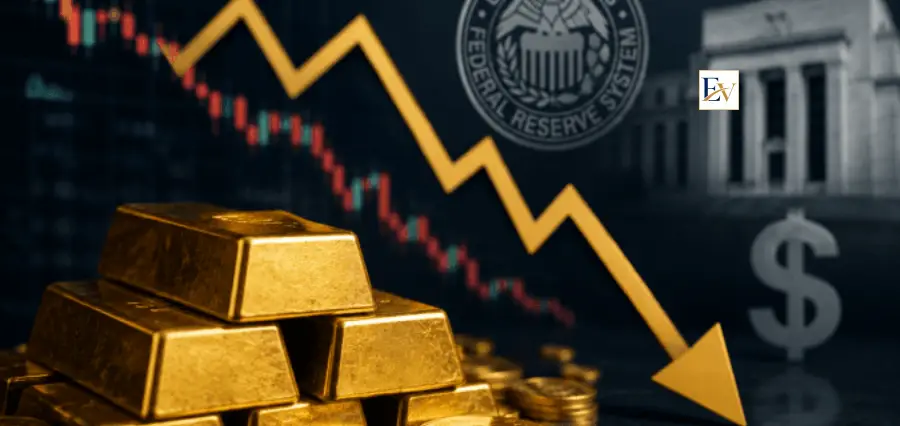
Gold Prices Decline as Investors Await US Election Results
Gold prices slipped on November 3 as a stronger US dollar and rising Treasury yields put pressure on bullion, while investors watched the US midterm elections for signals about future fiscal policy and financial market conditions.
Spot gold fell 0.5% to around $3,927 per ounce, after briefly dropping to an intraday low of $3,893.31. US gold futures for December delivery settled 0.7% lower at approximately $3,940.40 per ounce.
The decline came after gold had gained more than 2% in the previous session, supported by falling oil prices and easing inflation concerns. However, the recovery proved short-lived as currency and bond-market movements weighed on the precious metal.
Gold does not generate interest income, making it less attractive when government bond yields rise. A stronger US dollar can also make gold more expensive for buyers using other currencies, reducing international demand.
US Midterm Elections Add Uncertainty to Gold Market Outlook
Investors are closely monitoring the US midterm elections because the balance of power in Congress could influence fiscal policy, government spending, regulation and the administration’s ability to advance its legislative agenda.
A shift in congressional control could place pressure on the dollar if political divisions complicate decisions involving government borrowing and the federal debt ceiling. A weaker dollar could provide support for gold by making the metal more affordable to international buyers.
However, election-related uncertainty does not automatically translate into higher gold prices. Investors are also responding to interest-rate expectations, geopolitical developments and movements in other financial markets. These competing forces have made bullion’s near-term direction difficult to predict.
Developments involving the United States and Iran have added another layer of uncertainty. Meanwhile, changes in oil prices are influencing inflation expectations and the outlook for Federal Reserve policy. If energy prices remain elevated, the central bank could face pressure to maintain tighter monetary conditions, potentially limiting gold’s appeal.
Gold Faces Pressure From Interest Rates and Changing Investment Demand
The outlook for gold is also being shaped by expectations for US interest rates and changing investor demand. Market participants have continued to assess the possibility of another Federal Reserve rate increase in December. Higher rates generally raise the opportunity cost of holding non-yielding assets such as gold.
At the same time, gold has not consistently benefited from its traditional safe-haven status during recent market volatility. Some investors have been selling liquid assets to cover losses or meet margin requirements elsewhere, creating additional pressure on bullion even when uncertainty remains elevated.
The World Gold Council has also lowered its forecast for annual growth in gold investment demand to 200 metric tons from its earlier estimate of 400 metric tons, while raising its expectations for central-bank purchases. This points to differing trends between investment demand and official-sector accumulation.
Other precious metals also weakened during the November 3 session. Spot silver fell 1.9% to $49.69 per ounce, platinum declined 1.9% to $1,421.18, and palladium dropped 3.4% to $935.73.
Gold’s next move will depend on the interaction between the US election outcome, dollar performance, Treasury yields, Federal Reserve expectations and geopolitical developments. While uncertainty could eventually support demand for defensive assets, persistent strength in the dollar and higher interest rates may continue to constrain prices in the near term.
Read More :- Smart Investment Strategies: 8 Proven Ways to Build Long-Term Wealth



1 thought on “Gold Prices Fall Ahead of US Midterm Elections as Dollar Strengthens”