
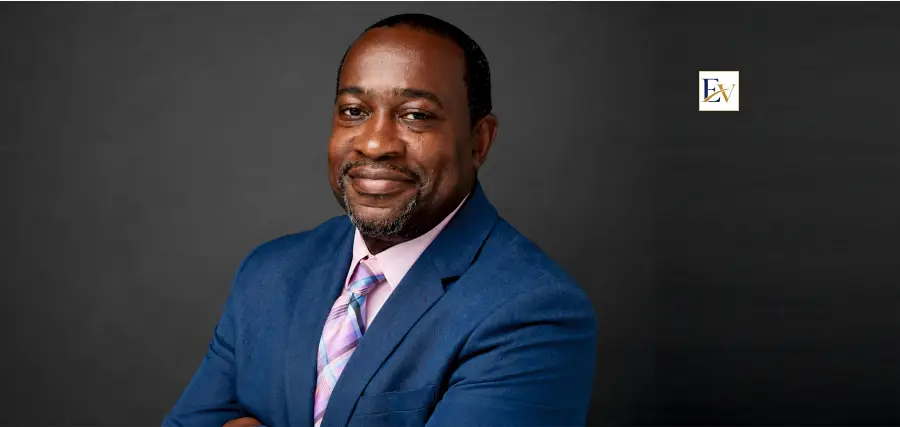
For many people, a successful career is defined by a respected position, a stable income, and the security of retirement. Ramel D. Lee saw a different possibility. He believed that even a strong paycheck and a pension could not provide the same level of control as ownership.
That belief became the foundation of his entrepreneurial journey.
Today, Ramel Lee is the Founder and Managing Partner of RD Lee Capital Partners, a boutique private equity and investment firm focused on building and acquiring businesses and real assets. His work spans hospitality, commercial real estate, security, logistics, private credit, venture investments, and small business acquisitions. Yet the thread connecting each chapter of his career is remarkably consistent: helping transform effort into ownership and ownership into greater control over one’s future.
His path, however, did not begin in finance.
It began in Brooklyn, where discipline, leadership, and the ability to perform under pressure shaped him long before he entered the investment world.
From the Quarterback Position to the Command Structure
Growing up in Brooklyn, Ramel learned early how responsibility can change the way a person sees the world. In 1995, he was the starting quarterback at Brooklyn Tech, a role that required more than athletic ability.
A quarterback must read the entire field, make decisions quickly, and accept responsibility for the outcome. That mindset would later become central to Ramel’s approach to leadership, business, and investing.
His professional career took him into public safety, where he spent 22 years with the New York State MTA Bridges and Tunnels. Beginning as an officer, he eventually retired as a Deputy Chief.
During those years, he also continued investing in his education. He earned a Bachelor of Science in Public Safety Management from SUNY Empire State, a Master of Science in Security Management from John Jay College, and a graduate certificate from Northwestern University’s School of Police Staff and Command.
The experience gave him a deep understanding of operations, systems, accountability, and human behavior under pressure.
It also taught him one of the most important lessons of his career: leadership cannot depend on personal effort alone.
In a large public agency, leaders often work with people who did not choose them and cannot simply be replaced when challenges arise. Ramel learned how to establish standards, communicate expectations, earn trust, and maintain accountability with fairness.
Those lessons would later prove just as valuable in entrepreneurship as they were in public service.
Building Beyond the Paycheck
While advancing through his public safety career, Ramel was quietly building businesses alongside it. His entrepreneurial involvement in hospitality began in 2006. He later founded RDL Security Solutions, growing the company into a seven-figure security services business.
Then came 2020.
For Ramel, that year represented a major turning point. He graduated from the Goldman Sachs 10,000 Small Businesses program, an experience that encouraged him to begin thinking less like an operator with a job and more like an investor responsible for building scalable enterprises.
At the same time, the world was entering the uncertainty of the pandemic. Rather than retreating from the disruption, Ramel identified an opportunity.
He launched RDL Logistic Solutions as an Amazon last-mile delivery partner at a time when demand for delivery services was accelerating. The business grew from zero to approximately $14 million in cumulative revenue over four years.
Scaling quickly brought its own pressures. The company had to manage hundreds of drivers, vehicles, safety responsibilities, compliance requirements, and the constant demands of a rapidly growing operation.
The experience tested every aspect of his leadership.
It also reinforced a lesson that would reshape his approach to business: growth without systems eventually becomes another form of dependency.
Ramel exited the logistics business in June 2024. The experience created liquidity, strengthened his investment track record, and helped position him for the next stage of his journey as a capital allocator.
From Operator to Capital Allocator
Ramel describes his evolution through three distinct stages: operator, owner, and capital allocator. In the early years, he handled everything himself. Sales, scheduling, payroll, operations, and crisis management often rested on his shoulders.
Over time, he learned that personal capacity would always have limits. The solution was not simply to work harder. It was to create systems, develop managers, and establish clear operating procedures.
That realization now shapes how he evaluates opportunities.
As Founder and Managing Partner of RD Lee Capital Partners, Ramel oversees capital allocation, deal sourcing, underwriting, investor relations, and the broader strategic direction of the firm’s ecosystem. He also remains involved in the operations of RDL Security Solutions and an office services business in Staten Island.
His approach is highly selective.
He evaluates opportunities based on whether they support one of three outcomes: capital formation, cash flow, or audience ownership. If an initiative cannot meaningfully contribute to one of those objectives within a defined cycle, it may be a distraction rather than an opportunity.
For an entrepreneur operating across multiple industries, focus has become one of his most important disciplines. As he sees it, great ideas are rarely the primary limitation. Execution bandwidth is.
That is why he believes ruthless sequencing often delivers more value than pursuing every promising opportunity at once.
Building an Ecosystem Around Ownership
RD Lee Capital Partners has evolved from a holding company for businesses Ramel founded into a broader investment and ownership ecosystem. The firm’s core focus includes hospitality, commercial real estate, security, logistics, and alternative investments such as private credit and venture.
Around those investment activities, Ramel is developing platforms designed to expand access to education, capital, and ownership.
One of those initiatives is RDL Hotel Fund I, a Regulation Crowdfunding hotel fund intended to open investment opportunities to everyday investors rather than limiting participation solely to traditional institutional or accredited investor networks.
Another initiative, the Unlimited Pension Collective, focuses on active and retired law enforcement professionals and public servants interested in alternative investments and long-term wealth building.
Through Protexpert Academy, Ramel also provides education, consulting, and practical resources for security entrepreneurs. Meanwhile, his Cop to Capital platform and newsletter share insights for professionals seeking to move beyond dependence on a paycheck and begin building ownership.
Together, these initiatives reflect a larger vision.
Ramel believes that many people, including public servants, first-generation investors, and individuals traditionally excluded from private markets, should have greater opportunities to understand and participate in asset ownership.
His mission is built around a simple progression:
“Effort becomes ownership, and ownership becomes control.”
An Operator’s Perspective on Investing
What distinguishes Ramel’s approach to investing is his background as an operator.
He has managed a security company, scaled a logistics business, and participated directly in hotel ownership. That experience has influenced how he looks at potential investments. For him, a financial model alone is not enough. He wants to understand how a business operates, where its systems are weak, what creates value, and whether the operation can continue performing without constant intervention from its founder.
This philosophy was demonstrated through his hospitality investments.
Ramel co-owned a Staybridge Suites in Scottsburg, Indiana, and a Hampton Inn and Suites in Indianapolis. The portfolio was acquired for approximately $17 million and sold roughly four years later for approximately $22 million, producing a reported 24 percent internal rate of return.
The transaction became an important validation of his investment model. But the financial result was only part of the story.
His businesses have also created employment opportunities for hundreds of people across security and logistics. Some employees entered with limited experience and later progressed into supervisory or management roles.
For Ramel, creating a path for people to move from employee to owner remains one of the most meaningful measures of impact.
Leadership Built on Clarity and Accountability
Ramel’s leadership philosophy can best be described as ownership-centered. He believes leaders should provide a clear destination, give people meaningful responsibility, and measure performance through objective standards rather than personal moods.
His teams operate through clear scorecards, recurring reviews, and consistent accountability. The goal is not to create dependence on the leader. It is to create an environment where people can take responsibility for real outcomes.
He also encourages team members to solve problems rather than simply follow instructions. Instead of giving someone a detailed script, he prefers to establish the problem and the boundaries, then allow the individual to develop a solution.
Once that solution proves effective, it can be transformed into a standard operating procedure. In this way, individual creativity becomes a lasting organizational asset. His definition of exceptional leadership reflects the same philosophy.
“Good leaders achieve results themselves.”
Exceptional leaders build people and systems capable of achieving results without them.
Meeting Disruption with Discipline
Ramel does not view uncertainty purely as a threat. He looks at disruption and asks a different question: What has this environment made cheaper, more available, or more attractive to a prepared operator?
That mindset influenced his decision to launch a logistics company during the pandemic. It also informs his current perspective on hospitality and real estate.
In his view, market conditions can create opportunities when assets trade below replacement cost and when prepared buyers have the discipline to underwrite for downside risk. His strategy is not based on pursuing innovation recklessly.
Instead, he follows a barbell approach.
Core businesses and investment activities rely on conservative underwriting and proven systems. New ideas receive limited resources, shorter testing periods, and clear criteria for determining whether they should continue.
Innovation must serve a practical purpose.
Within his businesses, technology is used to support underwriting, investor communications, standard operating procedures, and content development. He is also developing the Protexpert Guard Network, designed to connect licensed security guards with licensed companies in New York and New Jersey.
For Ramel, innovation is not a separate department. It is part of how a modern organization improves its ability to operate, communicate, and scale.
Resilience, Transparency, and Difficult Decisions
Entrepreneurship has also required Ramel to make difficult decisions. One of those involved restructuring the leadership of RDL Hotel Fund I when he concluded that the existing fit was not aligned with the level of confidence he wanted to provide investors.
The decision required removing respected partners from leadership roles.
He chose to act early and communicate openly because he believed that protecting investor trust had to take priority over avoiding an uncomfortable conversation.
Transparency remains central to his approach. He believes leaders must share the numbers, including the disappointing ones, and should earn credibility through consistency rather than promises.
That principle has become increasingly important in alternative investments, where trust is often one of the greatest barriers. Ramel’s businesses have also faced setbacks, including the loss of a significant security contract in 2025.
Rather than treating setbacks as reasons to abandon the mission, he uses them to reassess the operating model. Resilience, in his view, is the ability to remain steady when multiple challenges arrive at once.
When the numbers, people, or market conditions become difficult, the leader must often become the calmest person in the room.
The Next Phase of the Vision
Over the next three to five years, Ramel plans to continue expanding the RD Lee Capital Partners ecosystem.
His priorities include deploying RDL Hotel Fund I into economy and extended-stay hotel opportunities across the Southeast and Midwest, launching a deal-specific Fund II, and expanding the Unlimited Pension Collective and Cop to Capital into trusted communities for public servants seeking greater investment knowledge.
He also plans to develop Protexpert into a national security platform.
Among the opportunities he is watching closely are distressed hospitality and multifamily assets, particularly where pricing creates attractive entry points for disciplined operators.
He also sees significant potential in the coming transition of small businesses as many owners approach retirement without clear succession plans. Another major area of focus is the increasing democratization of private markets.
Technology, new investment structures, and evolving regulations are creating opportunities for more people to gain access to education, communities, and investment opportunities that were once available primarily to institutional participants.
For Ramel, however, access without understanding is not enough.
Education must come before action.
That is why his ecosystem combines capital with communication, mentorship, media, and community.
Building a Bridge That Lasts
Ten years ago, Ramel viewed success differently. Rank and a pension represented important milestones. Today, his definition has changed.
Success means freedom, assets that can generate income, businesses capable of operating independently, and the number of people who gain ownership because of the platforms and opportunities he helps create.
His long-term ambition is to build an ecosystem where capital, education, operating companies, and community strengthen one another. The ultimate measure of success will not simply be assets under management or the number of companies acquired.
It will also be the number of investors and entrepreneurs who begin with a paycheck and eventually own something of their own. That vision is deeply personal.
As a father, Ramel wants the next generation, beginning with his son, to understand that ownership is not a privilege reserved for a select group of people.
It can begin with learning, discipline, patience, and the willingness to take responsibility.
His own journey, from Brooklyn Tech quarterback to Deputy Chief, business operator, entrepreneur, investor, and Managing Partner, demonstrates the evolution of a leader who continually expanded his understanding of what responsibility could become.
For Ramel Lee, leadership is not about being the smartest person or working harder than everyone else.
It is about building the systems, opportunities, and pathways that allow other people to grow beyond dependence on a single paycheck.
His message to aspiring entrepreneurs, public servants, first-generation professionals, and future investors is clear: Start learning. Start small. Start building. And most importantly, start owning.
Because the philosophy that has guided Ramel Lee through every chapter of his journey remains as relevant to his future as it was at the beginning:
Effort. Ownership. Control. In that order.


1 thought on “Ramel Lee: Turning Effort into Ownership andOwnership into Freedom”